
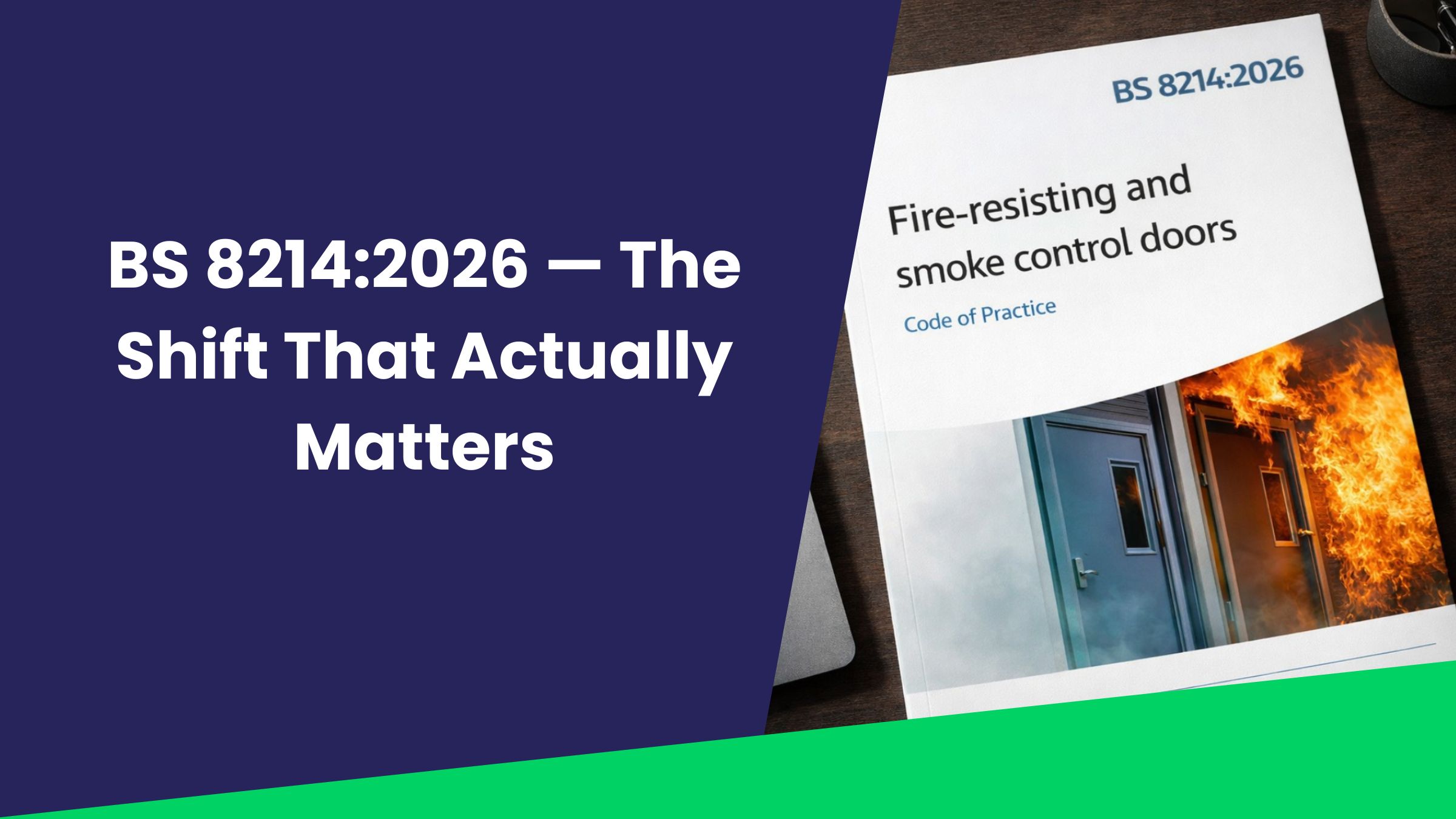
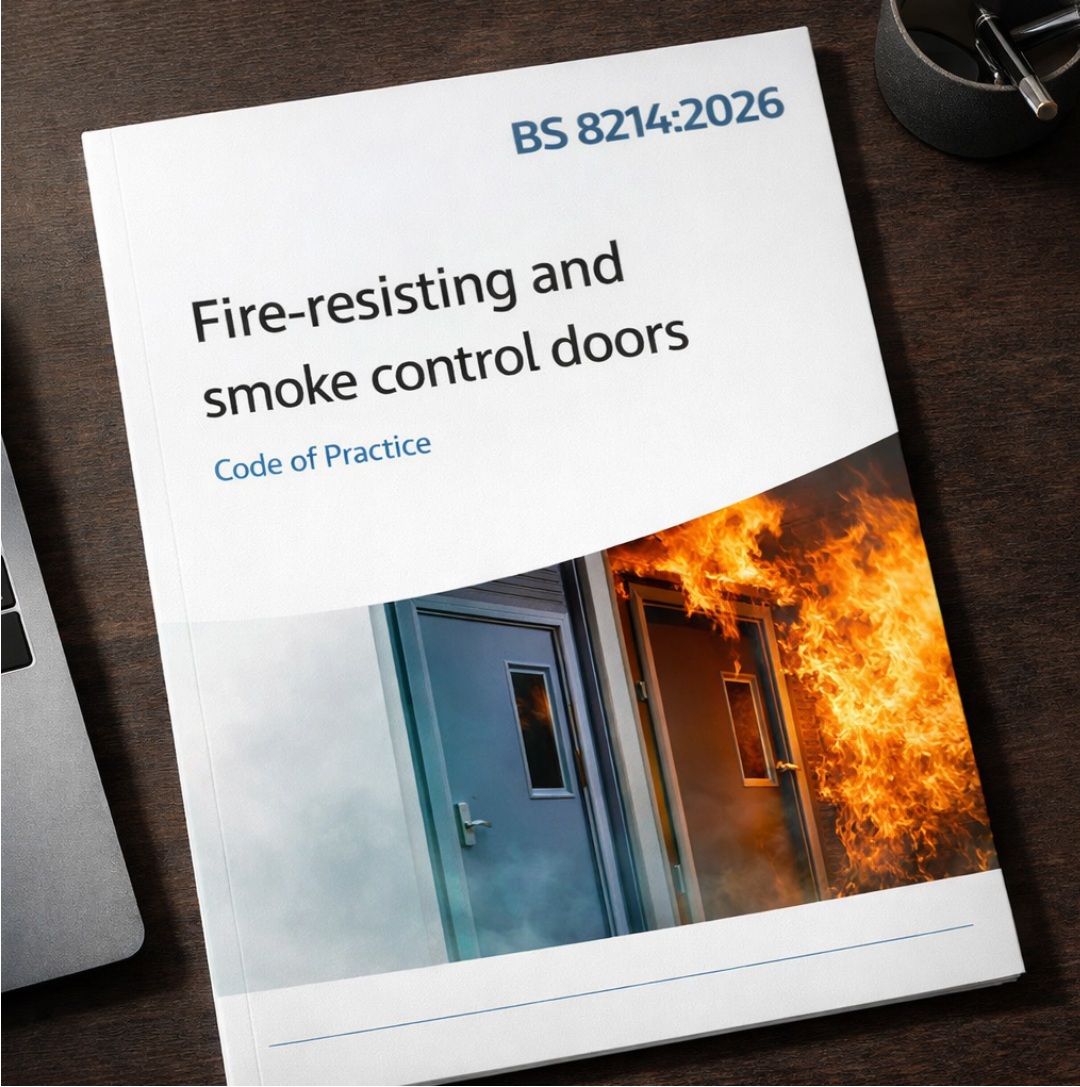
BS 8214:2026 is not a routine update. It changes how fire doors are thought about, specified and delivered in practice.
The 2016 version focused largely on timber door assemblies and gave fairly prescriptive guidance on how to install them.
The 2026 revision moves away from that completely. It reframes fire doors as complete systems, built on evidence, with clear responsibility across the entire supply chain.
From timber doors to complete systems
The scope has widened significantly.
BS 8214:2026 now applies to fire doors of all types, including timber, steel, composite and glazed systems. It also applies whether the product is supplied as a doorset, a door kit or an assembly.
The key point is that performance sits with the complete installed system, not individual parts.
This closes a long-standing issue where components were treated as “fire rated” in isolation. The standard is clear that only the full configuration, installed correctly, can deliver fire performance.
Roles and responsibility are now explicit
A major addition is a dedicated section on roles and responsibilities.
The standard now defines expectations for:
- Specifiers
- Manufacturers
- Door providers
- Installers
- Duty holders
- The wider supply chain
Each of these roles is responsible for maintaining the integrity of the specification and ensuring the door performs as intended.
This is a direct response to industry failure. Responsibility is no longer vague or shared in a way that allows gaps.
Supporting evidence is now central
This is the most important shift.
BS 8214:2026 places supporting evidence at the centre of everything.
That includes:
- Fire test reports
- Field of Application reports
- Technical assessments
- Third-party certification
Every fire door must now be specified, manufactured and installed in line with evidence.
If there is no evidence, there is no basis to claim performance.
The standard deliberately moves away from prescriptive rules and instead requires justification through documented evidence.

Changes are no longer minor
Under this standard, there is no such thing as a small change.
If you alter hardware, seals, glazing, dimensions or installation methods, you are making a design decision.
That decision must be supported by evidence. If it is not, you are outside the standard.
In many cases, the person making that change may be treated as a designer under CDM, with the associated responsibility.
Less instruction, more justification
The 2016 version told you what to do in detail.
The 2026 version expects you to prove that what you are doing is correct.
It removes a lot of prescriptive detail and replaces it with a requirement to demonstrate that the chosen approach is supported by evidence and aligned with tested performance.
This reflects how construction actually works now, where bespoke solutions are common.
Installation and interfaces are treated more seriously
There is clearer guidance on key risk areas such as the interface between the frame and the surrounding structure.
The use of materials like stone wool, mastics and foams is addressed more directly, but again the emphasis is on using solutions that are supported by evidence rather than assumption.
Competence runs through the entire document
Competence is embedded throughout the standard.
It is no longer enough to carry out tasks based on experience alone. Individuals and organisations must be able to demonstrate the skills, knowledge and behaviour required for the role they are performing.
This aligns with the wider shift under the Building Safety Act towards accountable duty holders and demonstrable competence.

A full lifecycle approach
The structure of the standard now follows the real lifecycle of a fire door.
It starts with roles and responsibilities, then moves through specification, supporting evidence, design, installation, handover and maintenance.
This reinforces a simple point. Fire door performance is not achieved at installation. It has to be maintained throughout the life of the building.
What this means in practice
BS 8214:2026 removes ambiguity and replaces it with traceability.
You can no longer rely on habit, precedent or what has “always been done”.
You need to be able to show:
- what was specified
- what evidence supports it
- how it was installed
- how it is maintained
If you cannot demonstrate that, you are exposed.
The bottom line
This standard is not about tightening installation detail.
It is about forcing the industry to move from assumption to evidence and from blurred responsibility to clear accountability.
Those already working properly will be aligned with it.
Those relying on shortcuts will struggle.


0 Comments