
Fire door regulations exist for a reason. They establish essential requirements for fire safety, helping to ensure that fire doors are correctly specified, installed, inspected and maintained to protect lives and property.
That gap between design and reality is exactly what the law now targets. Since the Grenfell Tower Fire, fire door duties have been rewritten, tightened and clarified. The result is a fog of acts, orders, regulations and British Standards that leaves landlords, managing agents and contractors unsure what actually applies to them.
This guide cuts through it. What the law says, what the guidance says, what the standards recommend, and who carries the can when a door fails.
The short version
- The core duty is the Fire Safety Order 2005. If you control a non-domestic building or the common parts of a block of flats, you must keep fire doors in efficient working order and good repair.
- Regulation 10 adds routine checks in England. In blocks with a top storey above 11m: communal fire doors every three months, flat entrance doors every 12 months on a best endeavours basis.
- Every block of flats with common parts must tell residents about fire doors, whatever its height.
- BS 8214:2026 is the current code of practice. It replaced the 2016 edition in March 2026 and now covers fire doors of all materials, not just timber.
- Competence is the thread running through all of it. Inspection, repair and replacement must be done by people who can evidence the skills, knowledge, experience and behaviours to do it properly.
Law, guidance and standards: know the difference
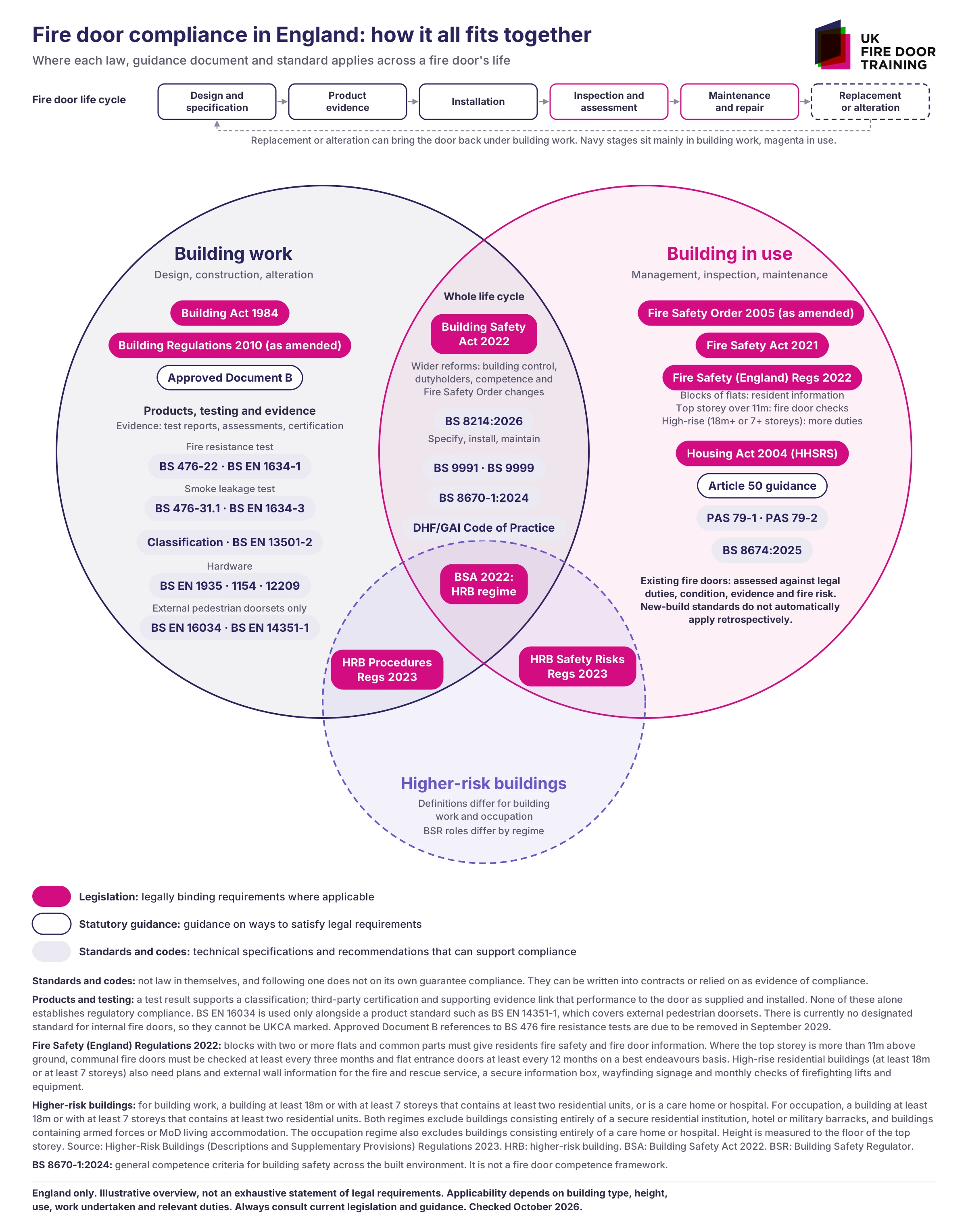
There is no single “Fire Door Regulations” document. There are three layers, and confusing them is where most compliance advice goes wrong.

Legislation tells you what outcome you must achieve. Guidance and standards tell you how. A British Standard is not law, but ignore one and you will struggle to show a court you did what was reasonable.
Fire Door Regulation foundations: the Fire Safety Order
The Regulatory Reform (Fire Safety) Order 2005 is the backbone. It applies to almost every non-domestic premises in England and Wales, including the common parts of blocks of flats. It places duties on the Responsible Person: the employer, owner or whoever has control of the premises.
Those duties include a suitable and sufficient fire risk assessment, and keeping fire safety measures, fire doors included, maintained in efficient working order and good repair.
Two post-Grenfell changes sharpened it:
- Fire Safety Act 2021. Removed any doubt that, in multi-occupied residential buildings, the Order covers the structure, external walls and flat entrance doors onto common parts. Your fire risk assessment has to consider them.
- Building Safety Act 2022, section 156. In force since 1 October 2023. Every fire risk assessment must now be recorded in full, whatever the size of the business. Responsible Persons must cooperate and share information with each other, and fines for some offences were raised.
In Scotland the equivalent duties sit under the Fire (Scotland) Act 2005. The rest of this guide focuses on England.
Regulation 10: the routine checks
The Fire Safety (England) Regulations 2022 came into force on 23 January 2023, implementing the Grenfell Tower Inquiry Phase 1 recommendations. Regulation 10 is the one that matters for doors, and it has two parts.
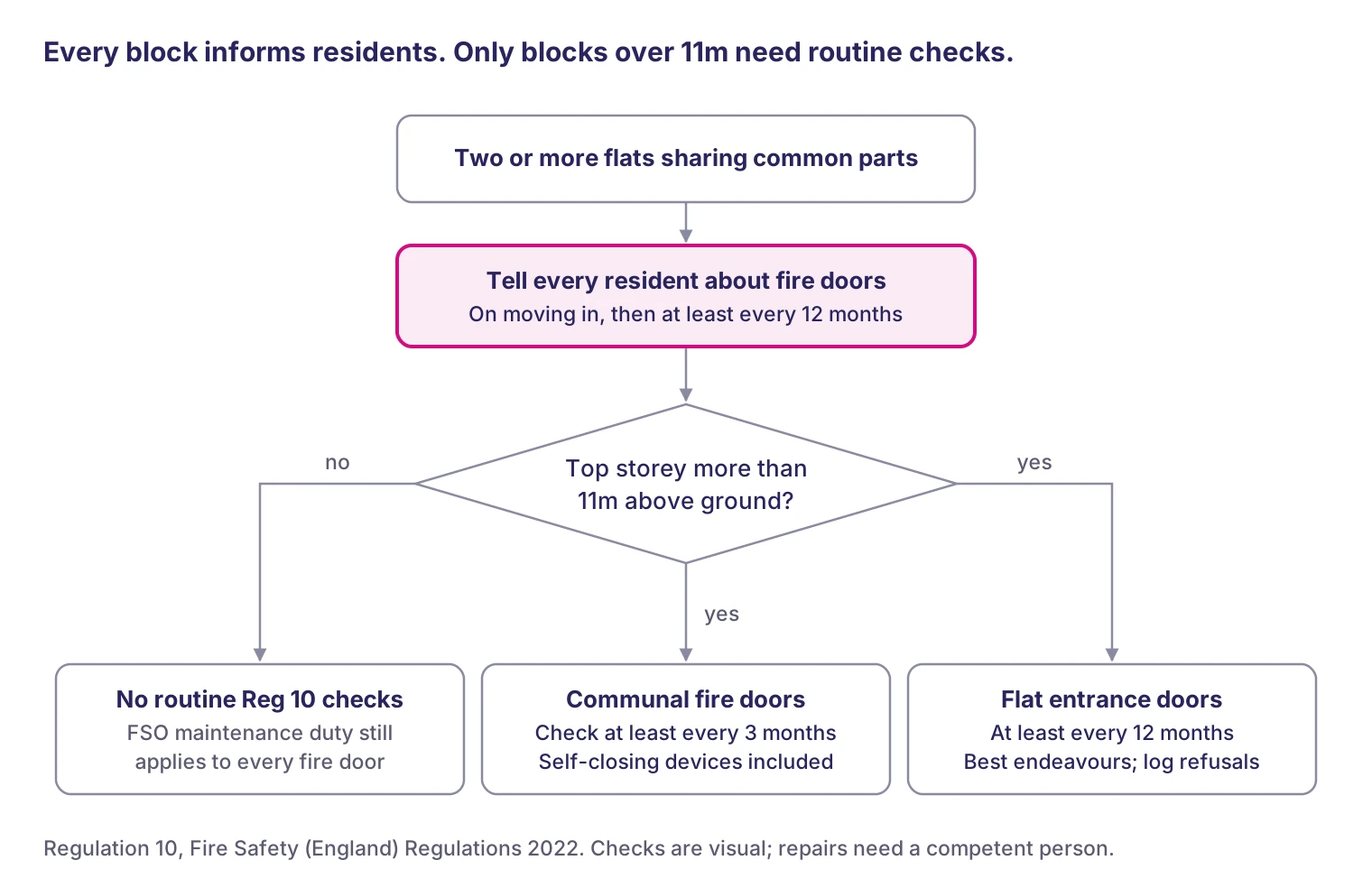
Resident information applies to every block with two or more flats and common parts. Residents must be told to keep fire doors shut, not to tamper with self-closers, and to report faults immediately.
Routine checks apply where the top storey is more than 11m above ground, typically five storeys or more. Communal doors are checked at least every three months. Flat entrance doors are checked at least every 12 months on a best endeavours basis, with failed access attempts recorded.
Fire door regulations recognise the importance of routine checks in maintaining fire safety. Official guidance makes clear that these checks are simple and visual, meaning caretakers and housing officers can carry them out with appropriate instruction. However, routine checks are not a substitute for a detailed fire door inspection or a suitable and sufficient fire risk assessment.

New and altered buildings: Approved Document B
Where fire doors are being installed as part of building work, the Building Regulations 2010 apply. Approved Document B is the statutory guidance on how to meet them, and its Appendix C sets the performance each door location needs.
The ratings you will see on labels and drawings:
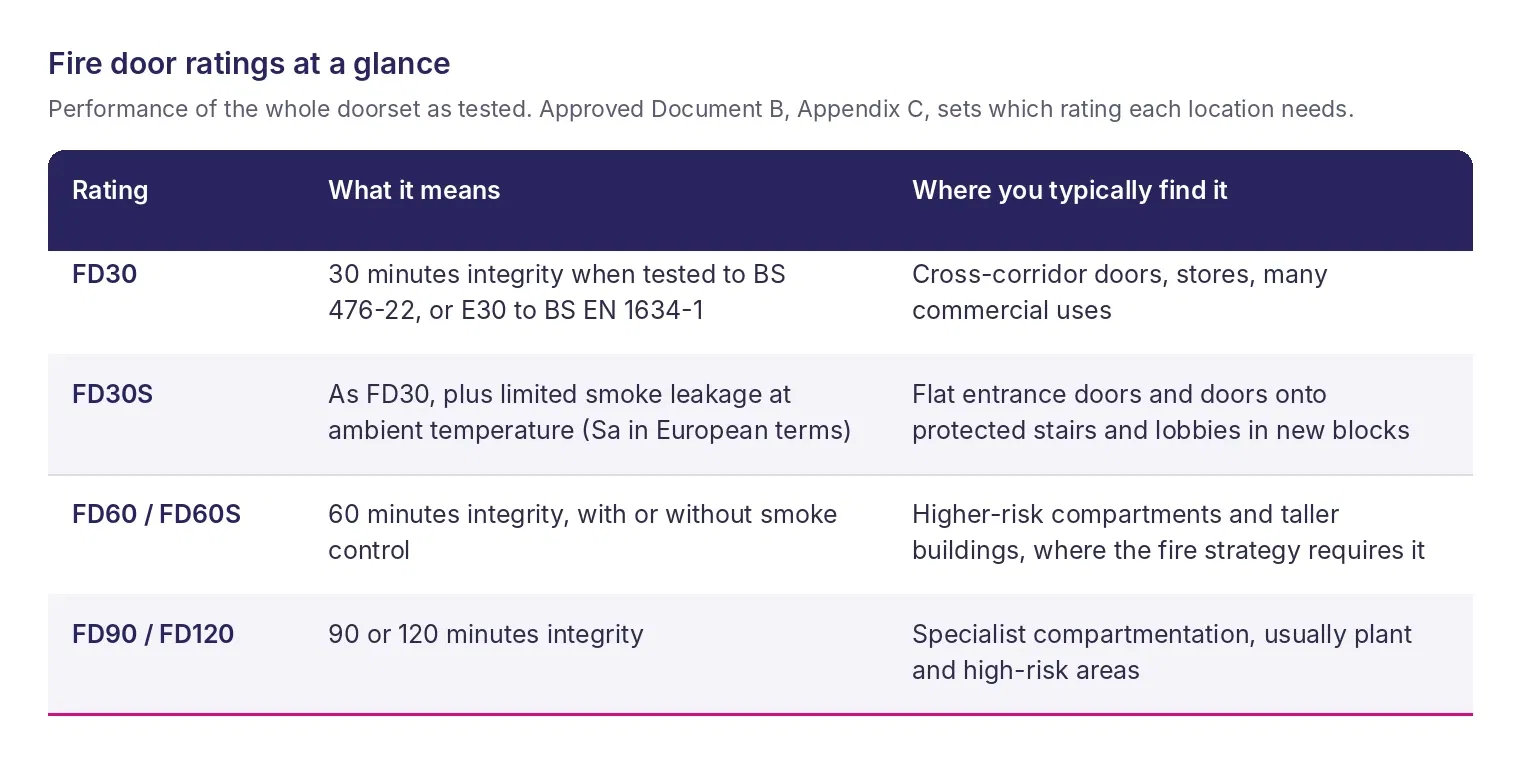
The number is a test result for the whole doorset as tested: leaf, frame, glazing, seals and hardware together. Swap one component for an untested alternative and the rating on the label may no longer mean anything.
BS 8214:2026: the new rulebook
BSI published BS 8214:2026 on 20 March 2026. It came into effect on 31 March 2026, replacing the 2016 edition, which is now withdrawn. It is a full revision, not a tidy-up.
What changed:
- Scope. The 2016 edition was built around timber. The 2026 edition covers pedestrian fire-resisting and smoke control doors of all types and materials, including timber, steel, glazed metal and composite, for new build and repair, maintenance and improvement work alike.
- The door as a system. It treats the fire door as a coordinated whole, however it arrives on site: assembly, doorset or kit. The clauses now follow the construction process, from roles and responsibilities through specification, evidence, installation, handover and maintenance.
- Evidence over prescription. Less prescriptive on construction and site work, more focused on the supporting evidence needed for any door. It covers both national and European classifications.
- Smoke control. Smoke control doors are now expected to be sealed at the threshold too. Rating smoke performance on the head and jambs alone is no longer accepted.
- Hardware, security and frame sealing. Clear warnings against swapping components without checking the specification, a dedicated annex on security fire doors, and clarified evidence requirements for stone wool, mastic and foam around the frame.
It is still a code of practice, not legislation. But it is the benchmark a fire risk assessor, an enforcing authority or a court will reach for first.
Anatomy of a compliant fire door
A fire door is not a door. It is a doorset, and every part has a job.
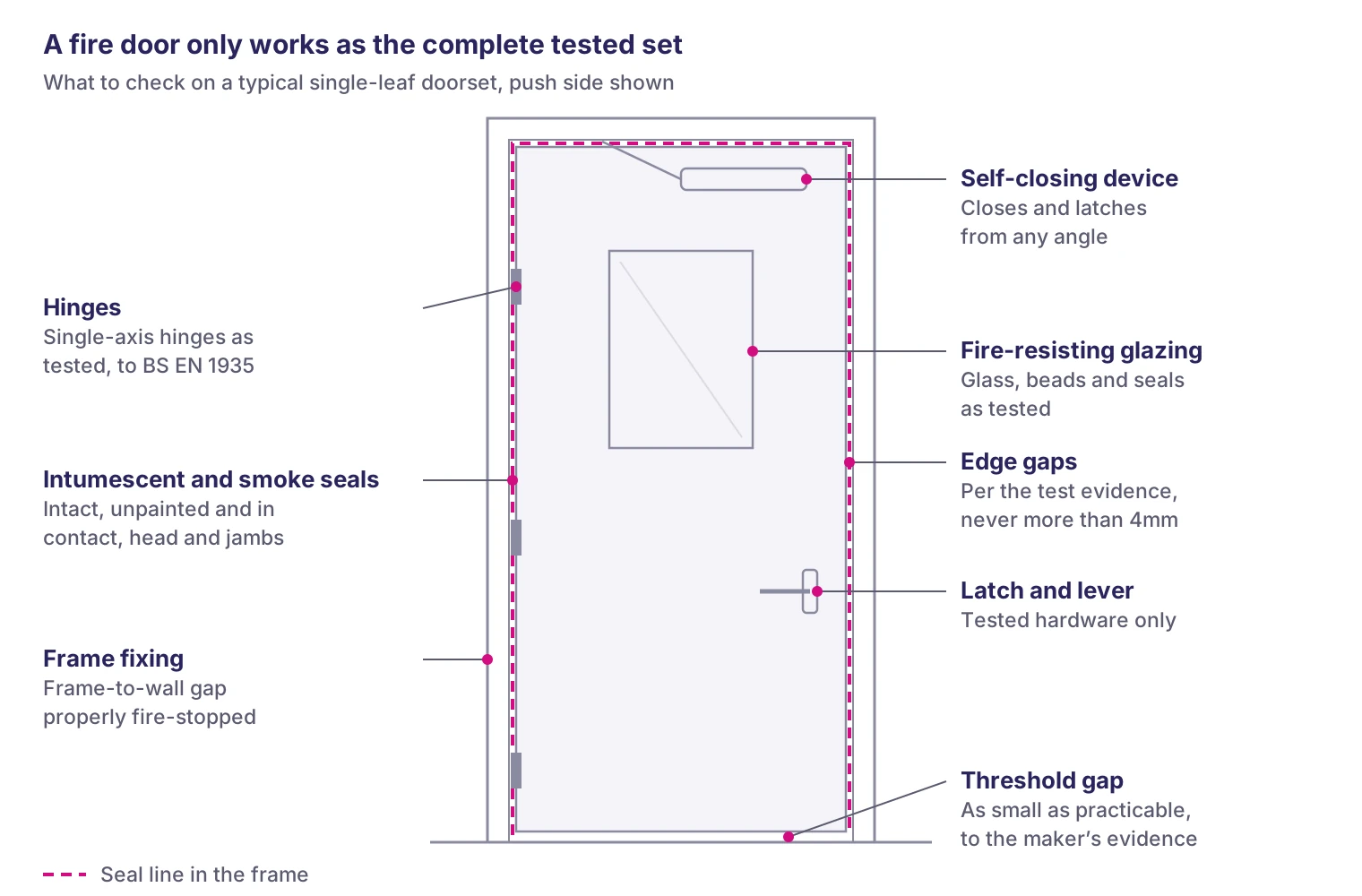
BS 8214:2026 is clear that edge and threshold gaps should follow the doorset’s own supporting evidence, not a rule of thumb. The government’s fire door guidance adds a simple ceiling for routine checks: never more than 4mm at the edges. Where smoke control is required, the gap under the door should be sealed too, typically with a drop seal.
The self-closer test is simple. Open the door fully and let go, then open it to around 15 degrees and let go. Both times it should close fully into the frame and latch.
Existing flat entrance doors: the 2025 reset
In August 2025 the government revised its fire door guidance, and it did not mince words. Leaseholders had been told to rip out perfectly serviceable flat entrance doors because they lacked a certificate or did not meet today’s new-build standard. That was never the intent.
The revised guidance makes three points worth pinning to the office wall:
- Regulation 10 is not an upgrade programme. It exists to make sure doors are kept in good order and are effectively self-closing.
- Old does not mean unfit. A door that met the standard when the block was built or the door was made will, in most cases, still be adequate if it is undamaged and the gaps are not too large.
- Missing seals or certification is not an automatic fail. Whether a door is adequate is a judgement for the fire risk assessment, not the quarterly checklist.
The practical takeaway: inspectors and assessors need to justify replacement recommendations against risk, not against a catalogue.
Who is responsible for what

If the roles overlap, as they often do in mixed-use and multi-owner blocks, the law expects those people to cooperate and share information. “I thought the freeholder did it” is not a defence.
Competence: the bit that holds it all together
Every layer of the framework assumes the work is done by someone who knows what they are doing. The guidance says repairs and replacements must be carried out by a competent contractor. BS 8214:2026 builds competence into every role, from specifier to maintainer.
Competent means you can evidence skills, knowledge, experience and behaviours. A certificate from a one-day course is part of that evidence. It is not the whole of it.
The failures we still see most often are not exotic:
- Doors wedged or propped open
- Self-closers removed, disconnected or too weak to latch
- Gaps well beyond 4mm after years of hinge wear
- Seals painted over or missing after redecoration
- Letterboxes, locks and spyholes retrofitted with no regard to the test evidence
- Frame gaps filled with whatever foam was in the van, with no test evidence behind it
Get these wrong in a building covered by the Fire Safety Order and the consequences are real. Serious breaches can mean an unlimited fine and up to two years in prison.
The bottom line
Fire door regulations establish clear responsibilities for building owners, responsible persons and those involved in fire door installation, inspection and maintenance. Understanding these requirements, maintaining accurate records and ensuring that work is undertaken by competent individuals are essential to achieving and demonstrating compliance.
Want to see what goes on inside a fire door before you inspect one? Explore our free, interactive Fire Door Anatomy CPD.


0 Comments