

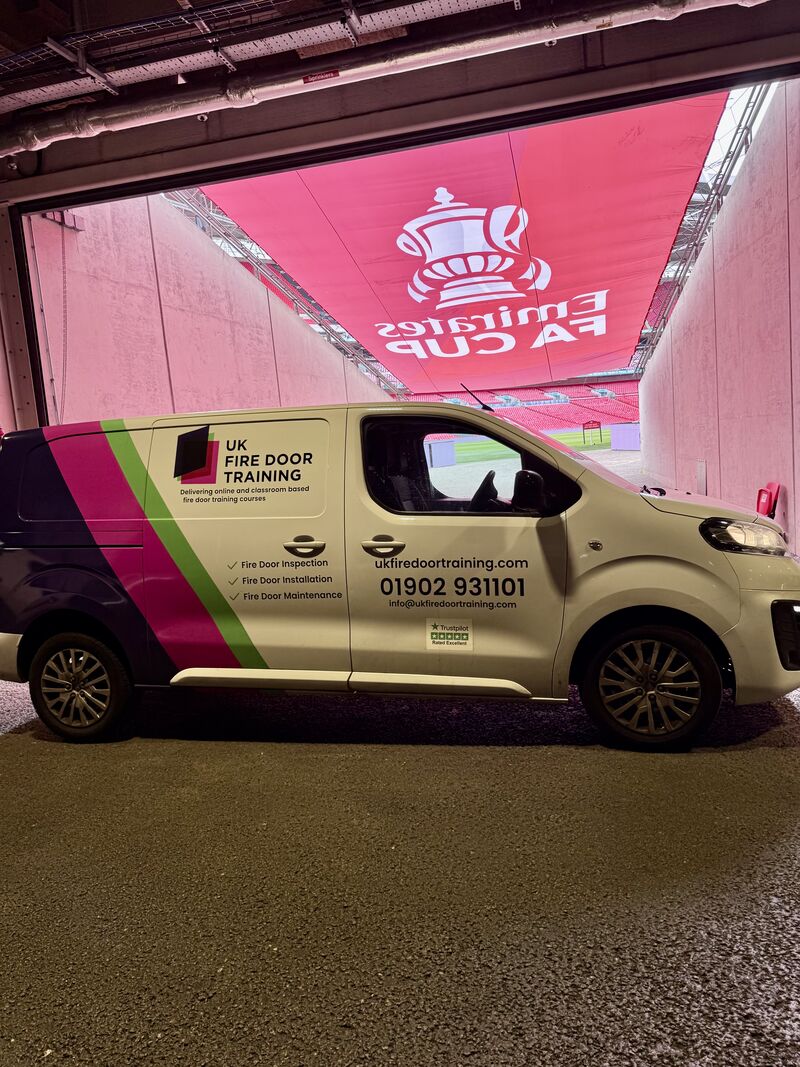
Not every training day starts with driving the company van into Wembley Stadium during FA Cup Final week.
But that is exactly what we did last week.
With Wembley Stadium fully prepared for one of the biggest fixtures in the football calendar, the match ball on display and winners’ podium rehearsals taking place, UK Fire Door Training was on site delivering a practical Fire Stopping Installation Course.
It was a memorable setting for an important subject.
Fire stopping is a critical part of passive fire protection. When installed correctly, fire stopping systems help maintain the fire resistance of compartment walls and floors by sealing service penetrations and helping to restrict the spread of fire and smoke. Yet, as the industry knows, poor installation remains a serious and recurring issue across the built environment.
That is why high-quality, practical fire stopping training matters.

Delivering a Practical Fire Stopping Course on Site
Our trainer, Ethan John (also a full time fire stopping installer at AJM & Co), delivered the course at Wembley Stadium, providing learners with a structured combination of technical knowledge and hands-on application.
The day was designed around the same principles that sit at the heart of our Fire Stopping Course offer:
- Clear, accessible theory
- Practical understanding of correct installation principles
- Exposure to common service penetration scenarios
- Hands-on work using appropriate materials and methods
- Training that reflects real site conditions, rather than purely classroom-based learning
The morning focused on the essential theory behind fire stopping, including the purpose of compartmentation, the importance of appropriate product selection, and the principles that underpin competent installation.
The afternoon moved into practical training, with our aluminium and steel mobile rigs set up on site to allow delegates to work across a range of penetrations. The practical activities used Nullifire products, giving learners direct experience of applying fire stopping systems in a controlled training environment.
This balance between technical understanding and physical installation is central to a credible Fire Stopping Installation Course. It is not enough to understand fire stopping in the abstract. Installers need to appreciate how systems are selected, how they should be applied, and how mistakes can compromise the intended fire performance of a building element.
Why Practical Fire Stopping Training Matters
A strong Fire Stopping Course should help learners understand not just what to do, but why it matters.
Fire stopping is often hidden once construction works are complete. That makes competence at the point of installation especially important. A poorly installed fire stopping system may not be obvious to the untrained eye, but its consequences can be serious.
Practical fire stopping training helps learners to:
- Recognise common installation challenges
- Understand the need to follow tested system details
- Appreciate the importance of substrate, service type and gap size
- Develop confidence in applying products correctly
- Avoid the assumption that “filling the hole” is the same as compliant fire stopping
This is precisely why UK Fire Door Training places such emphasis on hands-on learning within its Fire Stopping Installation Course. Learners benefit from being able to see, discuss and physically work through different scenarios rather than relying solely on slides or theory.
A Fire Stopping Installation Course Designed for Real-World Competence
Our approach to fire stopping training is built around real-world application.
The Wembley Stadium session was a strong example of how our Fire Stopping Installation Course can be delivered in a way that is both structured and practical, whether at our training facilities or directly on a client’s site.
Using our mobile rigs allows us to bring high-quality practical training into workplaces, venues and live operating environments. This gives organisations a flexible way to arrange training for their teams while still maintaining the practical integrity of the course.
For employers, contractors and facilities teams, this creates a valuable opportunity to:
- Train multiple members of staff at once
- Reduce travel disruption
- Focus learning on practical installation competence
- Create a more engaged training experience
- Support internal expectations around safer, more consistent workmanship
The session at Wembley Stadium reflected exactly that.

Training at One of the Most Recognisable Venues in the World
As a business, it was also a genuinely special moment.
UK Fire Door Training has come a long way in four years. To see our van, our logo and our Fire Stopping Installation Course inside one of the most iconic sporting venues in the world was both exciting and surreal.
Wembley Stadium is a place associated with major national moments. Cup finals, England internationals, concerts and historic sporting occasions have all taken place there. To be delivering specialist passive fire protection training in that setting was a proud moment for the team.
We are grateful to everyone at Wembley Stadium for having us and for being generous enough to give our trainer a tour during what was clearly an exceptionally busy week.

Fire Stopping Course Delivery for Organisations
UK Fire Door Training delivers fire safety and passive fire protection training for individuals, contractors, employers and major organisations across the UK.
Our Fire Stopping Course and Fire Stopping Installation Course options are designed to support stronger technical understanding, greater confidence and more competent practical application.
Training can be delivered through scheduled course dates or, where suitable, arranged directly for organisations requiring group delivery.
For businesses that want fire stopping training to be practical, credible and relevant to the realities of installation work, our approach is built around more than attendance. It is built around competence.
Find out more about our Fire Stopping Installation Course and upcoming Fire Stopping Course dates.



0 Comments